
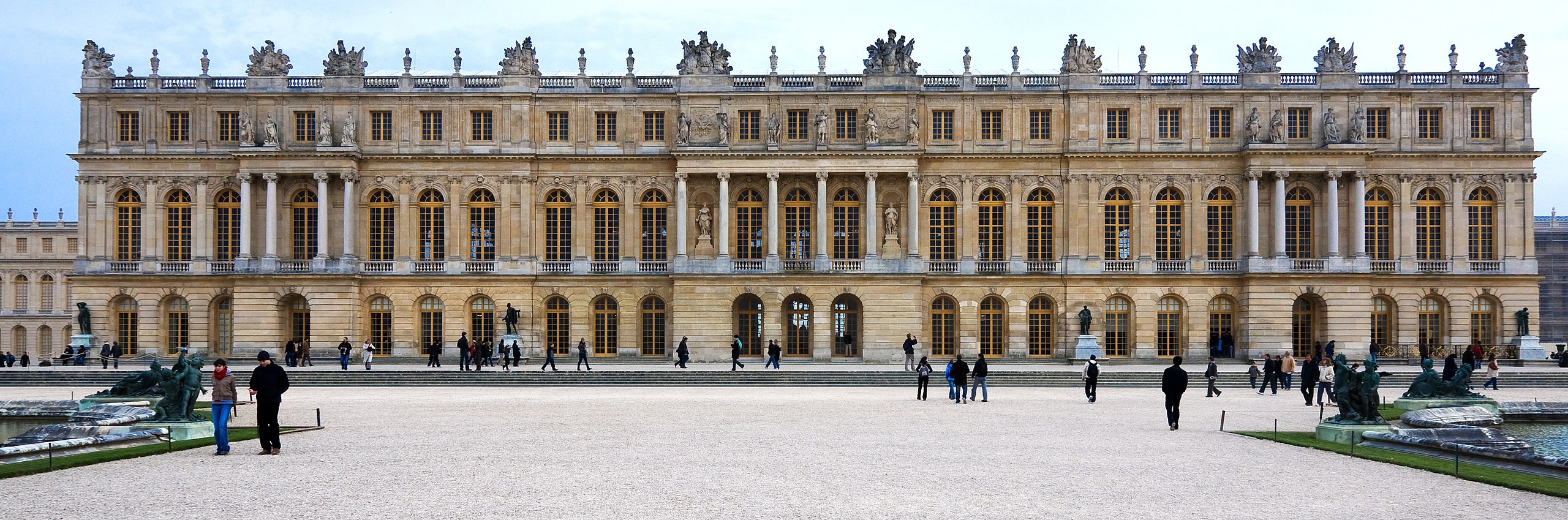
Palace of Versailles
The Palace of Versailles, located about 20 kilometers west of Paris, is one of the most famous architectural wonders in the world and a symbol of power and opulence of the French monarchy. Its construction began in 1623 as a modest hunting lodge for Louis XIII, but it was under the reign of Louis XIV, the Sun King, that Versailles was transformed into a magnificent royal palace.
Louis XIV, who ascended to the throne in 1643, began the expansion of the palace in 1661, entrusting the project to the architect Louis Le Vau, the painter and decorator Charles Le Brun, and the gardener André Le Nôtre. These artists and craftsmen collaborated to create a residence worthy of the most powerful monarch in Europe. Versailles became not only a royal residence, but also the political and administrative center of the kingdom. In 1682, Louis XIV officially transferred his court and government from Paris to Versailles, consolidating the palace as the heart of French power.
The architecture of Versailles is a triumph of French classicism, with baroque elements that enhance its grandeur. One of its most iconic features is the Hall of Mirrors, designed by Jules Hardouin-Mansart, who replaced Le Vau after his death. This gallery, 73 meters long, is decorated with 357 mirrors that reflect the light from the 17 arched windows overlooking the gardens. It was the place where the most important receptions took place and where Louis XIV displayed his magnificence to foreign dignitaries.
The gardens of Versailles, designed by André Le Nôtre, are another masterpiece that extends over 800 hectares. The gardens are characterized by a perfect balance between nature and art, with fountains, sculptures, and geometric flowerbeds arranged harmoniously. The Grand Perspective, a long avenue that winds from the palace to the Grand Canal, is one of the most iconic views and symbolizes the order and control that the king exerted over the kingdom and nature.
Versailles is not only a place of extraordinary artistic beauty, but also the stage for important historical events. One of the most significant moments in its history is the March on Versailles on October 5, 1789, when thousands of Parisian women marched on the palace to protest against the scarcity of bread and social inequalities. This event marked the beginning of the French Revolution and led to the end of absolute monarchy in France. The women managed to force King Louis XVI and his family to move to Paris, marking a radical change in French history.
During the 19th century, after the French Revolution, Versailles underwent several changes. Napoleon Bonaparte used the Grand Trianon as a summer residence, but it was only under Louis Philippe I, who reigned from 1830 to 1848, that the palace was transformed into a museum dedicated “to all the glories of France.” Louis Philippe wanted to preserve and celebrate the history of France by turning the palace rooms into galleries that tell the national history through paintings, sculptures, and other artifacts.
The beauty and historical importance of Versailles were internationally recognized when the palace and its gardens were declared a UNESCO World Heritage Site in 1979. This recognition has helped preserve the site for future generations and highlight its significance as a historical and cultural monument.
Read More