
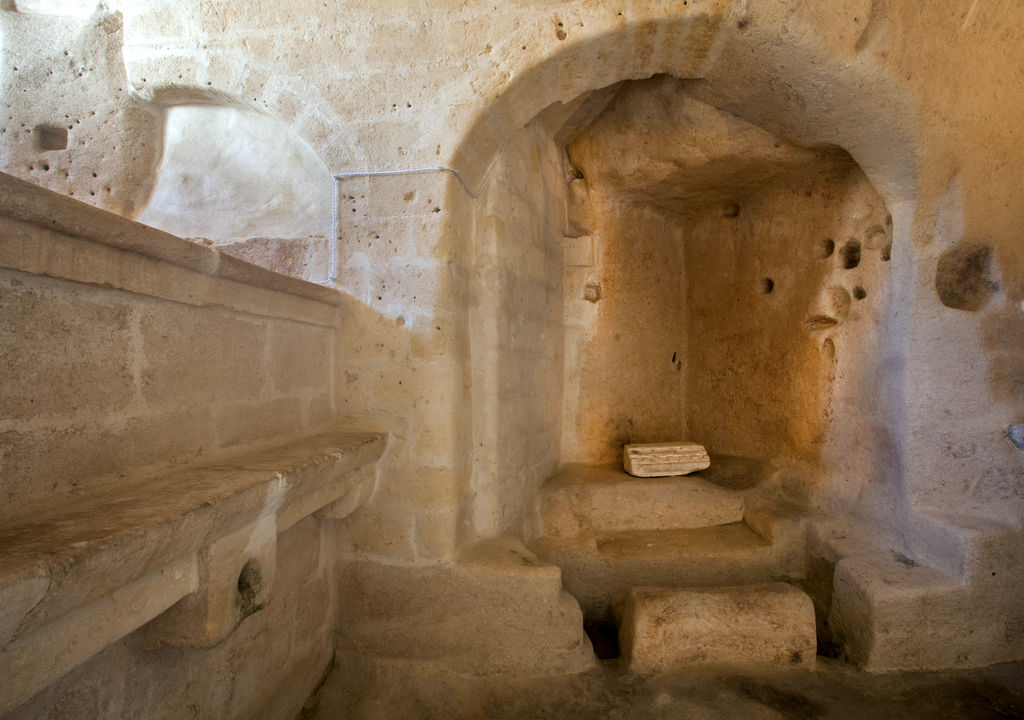
Crypt of Saint Andrew
The Crypt of Saint Andrew, located in the Sasso Caveoso of Matera, is a fascinating testimony of monastic life and medieval religious culture in the city. This ancient place of worship, dating back to the 12th-13th century, is an example of rock-cut architecture, entirely carved into the limestone rock that characterizes the region.
The crypt consists of three main rooms, each progressively descending into the tuffaceous bench. The entrance is at street level and leads to the first room, characterized by a plan resembling the Latin cross. In this space, there are two rock presses, used for grape pressing, evidence of the later use of the crypt as a wine cellar. Crosses are engraved on the walls, a reference to the original function of the place as a cenobitic church, where monks would retreat for prayer and meditation.
On the floor of the first room, the mouths of two cisterns open, with the typical ogival shape, carved into the floor. The first cistern received rainwater through a still visible channel, connecting it to a small external courtyard. The second cistern was connected to the first through an overflow system, allowing excess water to pass from one cistern to the other. This sophisticated water collection system testifies to the ingenuity of the ancient inhabitants of the Sassi, who utilized every natural resource available to them.
Descending through a sloping staircase of about thirty degrees, you reach the second chamber, characterized by an arched passage also carved into the rock. In this room, there are two long walls that supported barrels for wine maturation. This use as a cellar is an example of how religious spaces have often found new uses over the centuries, adapting to the needs of the local community.
The third chamber is the deepest and is reached through another staircase with the same slope as the previous one. Here, there are walls for the barrels and a niche carved into the back wall, typical of many hypogea in the Sassi. During restoration work, a burial was found in this chamber, likely belonging to a prominent member of the monastic community. Additionally, an fresco depicting a Blessing Christ was discovered above the vault, partially damaged but still visible.
The crypt is also known for the particular cross engraved on the lintel of the entrance to the first room, a cross inscribed in a circle with the arms placed diagonally (cross decussata). This symbolic decoration led to the association of the crypt with Saint Andrew, suggesting that it could have been a place of worship dedicated to the saint already in medieval times.
The history of the Crypt of Saint Andrew goes beyond its religious function. Over the centuries, this space has also been used for secular purposes, such as wine production, a fundamental economic activity for the Matera community. The presses and cisterns in the crypt testify to this transformation and offer a glimpse into daily life in the Sassi.
From an artistic point of view, the crypt preserves important evidence of rock painting. The frescoes, although partly damaged by time and humidity, represent a significant example of medieval sacred art. The depicted figures, often stylized and simple, convey a sense of spirituality and devotion that reflects the monastic life of the time.
The Crypt of Saint Andrew is also a place of great archaeological interest. Discoveries made during restoration work, including human bones and ceramic fragments, have allowed the reconstruction of the site’s history and a better understanding of medieval funerary practices. These artifacts offer a valuable insight into the religious and daily life of the communities that revolved around the Sassi of Matera.
Today, the Crypt of Saint Andrew is open to the public and represents one of the must-see stops for those visiting Matera. Its exploration offers a fascinating journey through time, allowing you to discover the historical and cultural roots of the city.
Read More